A custom applicator doesn't get paid
to spray dirt.
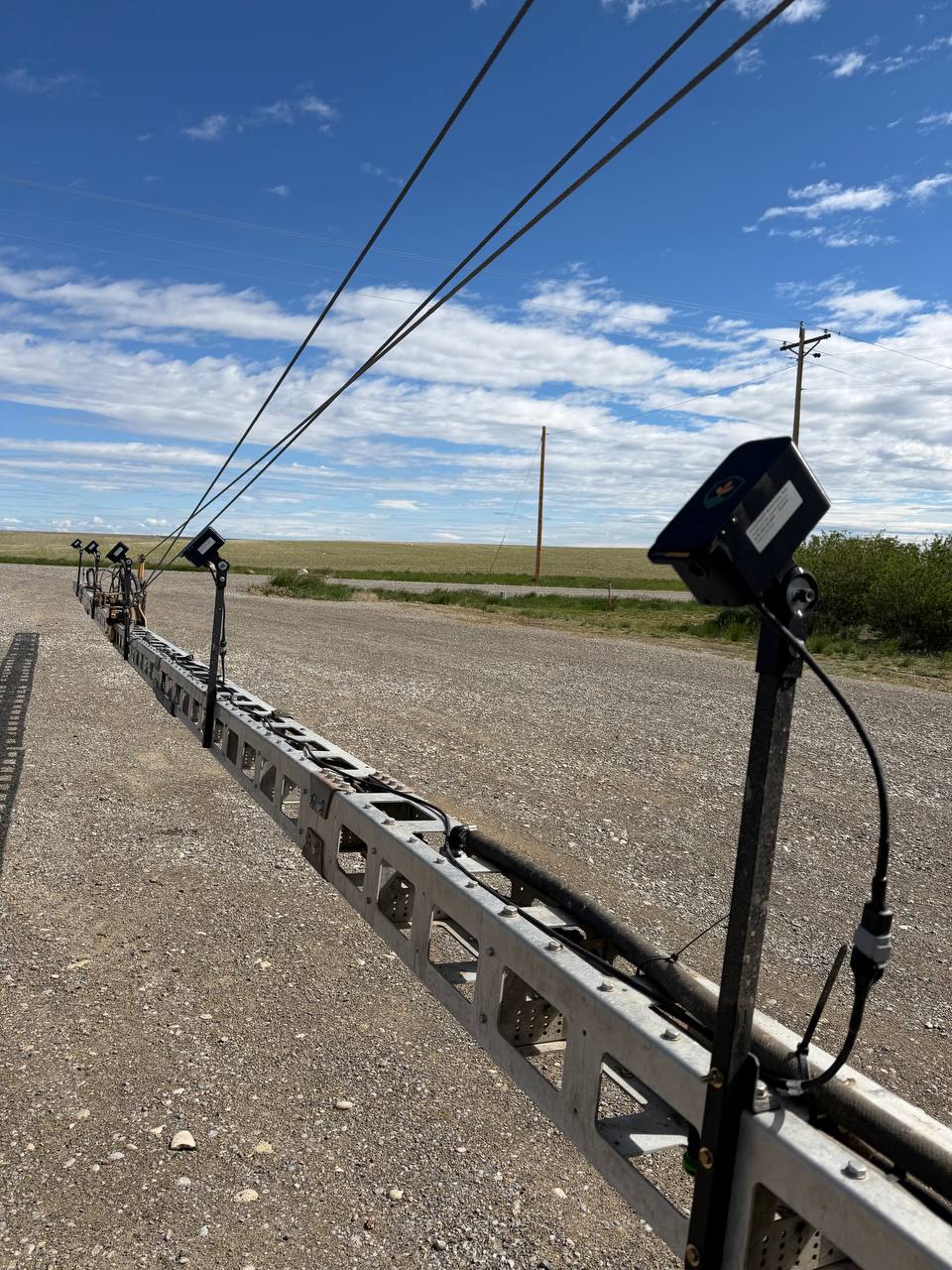
Michael Moore runs No Moore Weeds out of Choteau, Montana — custom application across other people's ground, where every gallon in the tank is a cost he carries. His 120-foot Sprayflex mid-mount now runs FarmDefender: eleven cameras watching the full boom, nozzles firing only where there's a weed. Spot-spraying since July 2026.
The challenge
Custom application is a margin business. The applicator buys the chemical, carries it across somebody else's acres, and eats the cost of everything that lands where a weed isn't. On fallow and pre-emergence work — where the target is scattered plants on mostly bare ground — broadcast spraying means paying full rate to treat a field that's largely empty.
Every operator knows this. The reason broadcast persists is that the alternative has to work at real speed, across a real boom, without adding a person to the cab or a week of setup to the season. A system that needs babysitting doesn't survive a custom applicator's schedule.
Michael's requirement was blunt: cover the whole 120 feet, keep up with how he actually drives, and run on the sprayer he already owns.
The solution
FarmDefender puts eleven cameras across the full 120-foot boom — no gaps, no sampling, no "representative" section standing in for the rest. Each camera runs detection on its own strip of ground in real time and decides, nozzle by nozzle, what opens.
Nozzles sit on 50 cm spacing and the system controls them individually. That's the difference between spot spraying and section control: a section valve shuts off ten feet of boom, while FarmDefender is making the call at one nozzle.
The system drives Michael's existing CapstanAg PinPoint III nozzle control — FarmDefender decides, the PinPoint hardware actuates. No new sprayer, no new terminal in the cab, and the machine still runs conventionally whenever he wants it to.
The chemical you don't spray is the margin you keep.
For an owner-operator spraying their own ground, saved chemical is a saved input cost. For a custom applicator, it's the same saving on far more acres in a season — the machine is running somebody's field nearly every day of the window.
The savings scale with how empty the field is. Fallow and pre-emergence passes, where weeds are scattered across bare ground, are where spot spraying separates hardest from broadcast. A thick, uniform infestation is where it separates least — and we'd rather say that plainly than quote a number that only holds on a good day.
Michael's rig has been spot-spraying since the end of July 2026, on his own sprayer, on his own schedule.
What deployed
FD-120 spot spray
Eleven cameras across a 120-foot Sprayflex mid-mount. Full-boom coverage at working speed, with the spray decision made per nozzle rather than per section.
Runs the existing nozzle control
FarmDefender commands Michael's CapstanAg PinPoint III system. The sprayer keeps its own plumbing, its own valves, and its own conventional broadcast mode.
Installed and supported by FarmTech
We built the kit, installed it on the machine, and commissioned it in the field. When something needs attention mid-season, it's the people who built it who show up.
Spraying acres that are mostly bare?
Fallow and pre-emergence work is where spot spraying pays hardest. Tell us your boom width, your nozzle spacing, and what you're spraying — we'll tell you straight whether it's worth it on your operation.