The crop's in the bin. Next up is fertilizer, and a lot of it gets booked over the winter. The usual math is one rate per field, times the acres. It assumes every acre in that field needs the same thing.
A soil map shows what each part of the field needs before you commit to the tons. You can still get one this fall.
Why map soil before you book fertilizer?
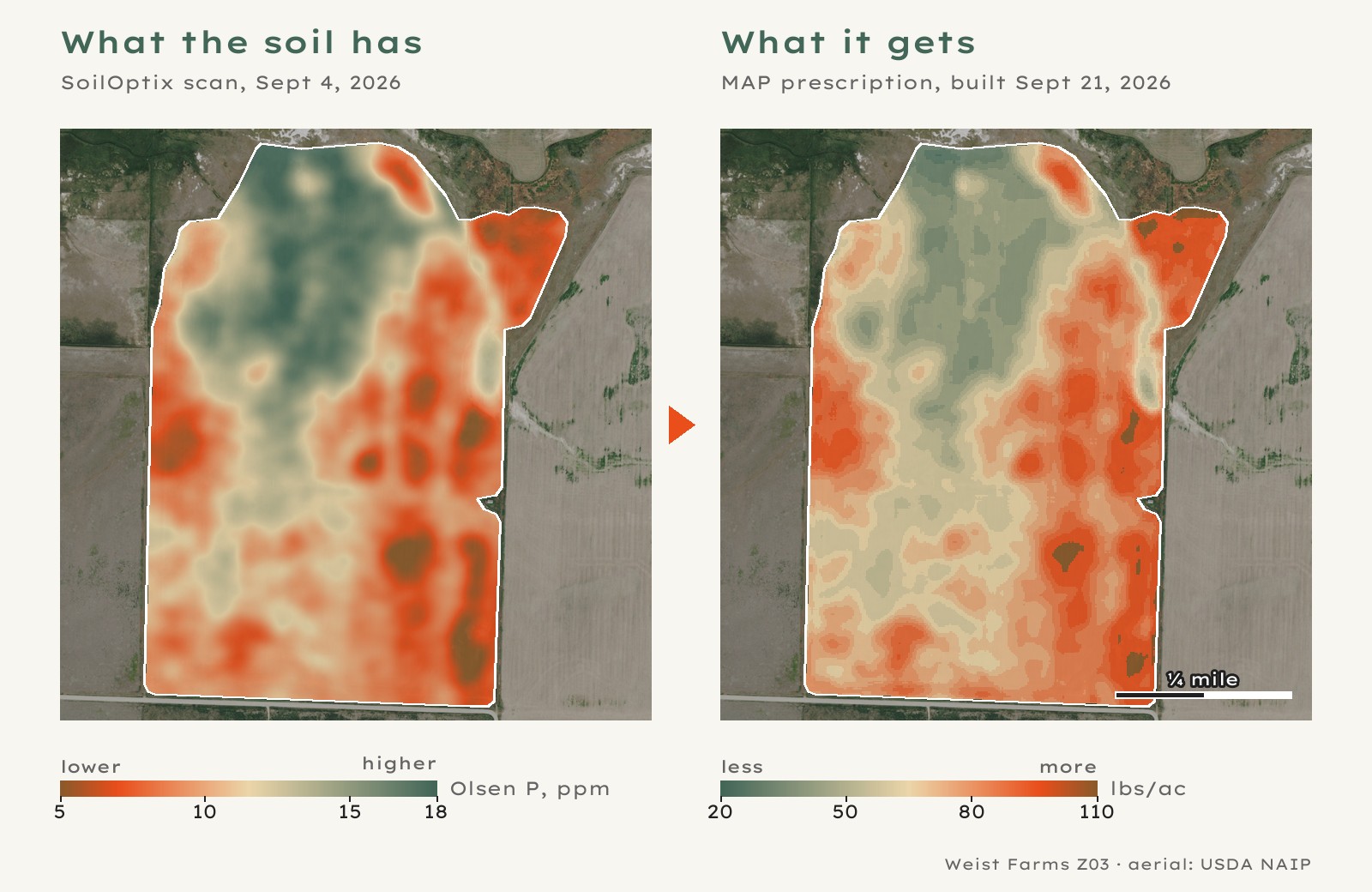
One field can need very different amounts. On Weist Farms' W02 spring wheat, MAP ran from 15 to 125 lbs an acre. That's an 8x range in one field. A flat rate picks one number, so part of the field gets too much and part too little.
Build the prescription first and you know what each zone calls for before you book a ton. (More in Why Variable-Rate Fertilizer?)
Can you soil-scan in November, on frozen ground?
Yes. Frozen ground is fine; only big snow drifts or ice stop a scan. If you recrop or irrigate, scan right behind the combines. On crop-fallow ground, scan the fallow, spring through summer. So stubble going back to crop next spring can be scanned now, as long as it isn't drifted in.
What does a SoilOptix scan measure?
The SoilOptix scanner reads the natural gamma radiation coming off the soil and builds a 10×10-foot map from about 335 scan points per acre, not averaged zones. The scan also tells us where to pull samples. Those go to the lab to calibrate the maps.
What comes back:
- Nutrients: nitrogen, phosphorus, potassium, calcium, magnesium and sulfur, plus optional micronutrients.
- Organic matter and pH: including buffer pH for lime.
- EC, CEC and texture: the sand, silt and clay behind the corner that always dries out first.
None of this is new to us. We've scanned with SoilOptix since 2019 and written variable-rate prescriptions since the early 2000s.
What does soil scanning cost per acre?
SoilOptix scanning is $12.50 an acre, lab-analyzed samples included. One scan is good for five crop seasons before a rescan. Prescriptions are separate. FarmIQ™ Soil RX is $0.50 an acre per nutrient, or $2.50 an acre for all maps, with unlimited runs each crop season.
Most operations recover the cost in fertilizer savings the first season. Everything else is on the price list.
Will the prescription run on my seeder or spreader?
It should. Tell us what's in your cab and we verify the file format before it matters. You get ISOXML for the cab, plus shapefiles for GIS and a PDF for review. They run on John Deere, Case IH, New Holland, Ag Leader, Trimble, Raven and Topcon, or any variable-rate system.
The W02 file loaded to the Topcon terminal and the seeder applied it May 6, 2026, the day it arrived. No GIS consultant, no conversion. That handoff is what changed. FarmIQ Soil RX replaced the hand GIS work, so every field gets a repeatable prescription.
Who does the work?
We do. We scan, pull the samples, handle the lab, build the prescription and get it onto your display. Every soil map's agronomic story comes through Bridger Thompson on our team. The maps land in FarmIQ beside your satellite and machine data.
Your data stays yours. We don't sell it, aggregate it or share it (our data philosophy).
Frequently Asked Questions
Do I have to rescan every year?
No. One scan is used for five crop seasons before a rescan, and Soil RX rebuilds the prescription from it each season.
Can I start with one nutrient on one field?
Yes. Soil RX is priced per nutrient at $0.50 an acre, so phosphorus on one field is a fair place to start.
Do I need yield data from my combine?
No. Soil RX works without combine yield data. If yours lives in John Deere Operations Center or CNH AFS, FarmIQ can pull it in.
Do I get the raw data, or just a report?
Everything: the point-sample dataset, raster maps for each nutrient layer, shapefiles, ISOXML prescriptions and a written agronomic summary.
Booking fertilizer this winter? Call or text (406) 271-6400, or email support@farmtech.us. Tell us your fields and we'll tell you straight whether a scan pays.