
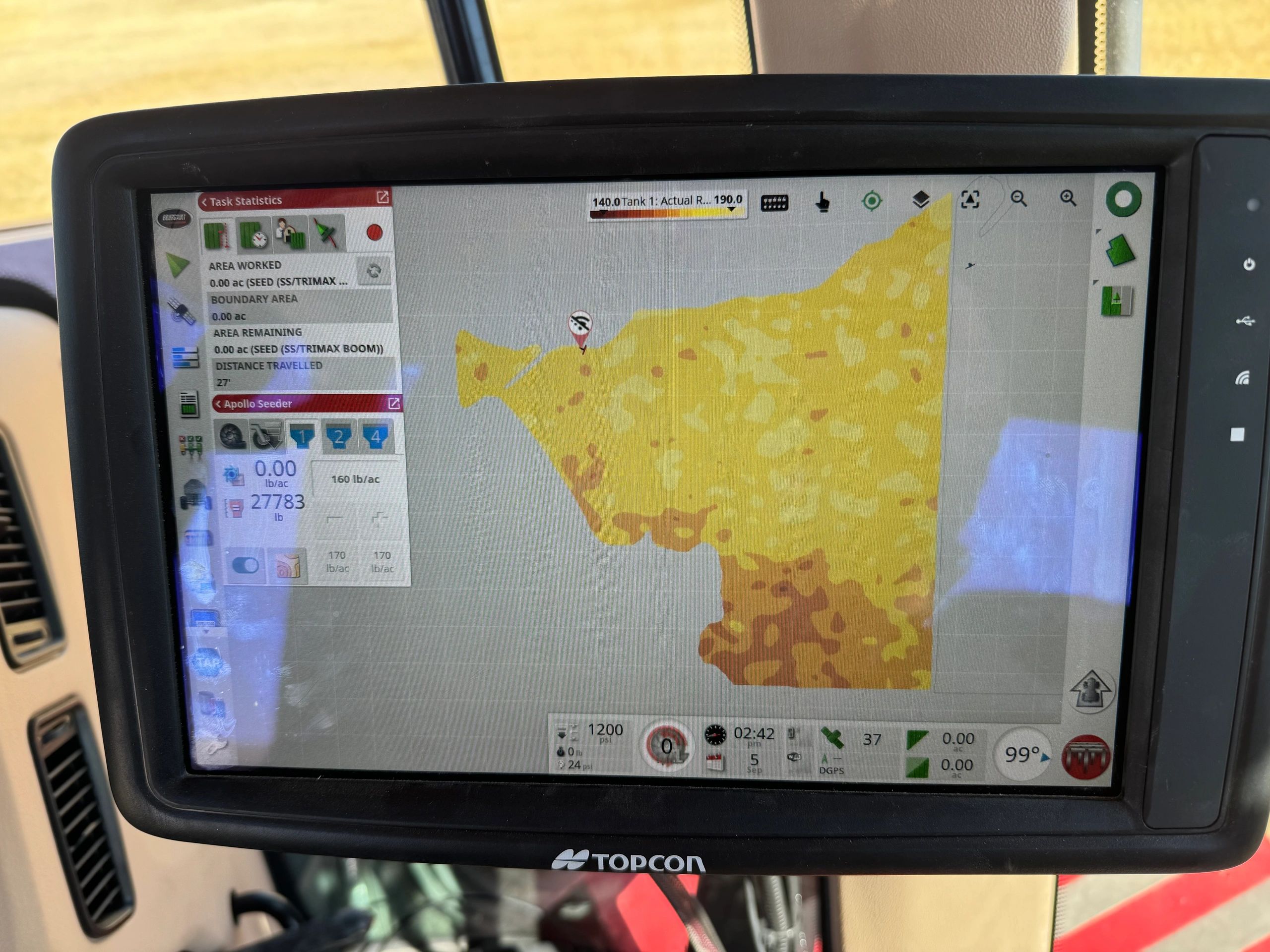
Your field isn't uniform. Soil organic matter, pH, and phosphorus change across a quarter section — sometimes dramatically. A flat-rate application treats the whole field the same; variable-rate doesn't.
Zones that test high don't need the same input as zones that test low. A flat rate over-applies on good ground and under-applies where the crop would respond — leaving yield on the table and paying for fertilizer that doesn't earn its keep.
What makes it work — or not
Variable-rate application is only as good as the zone map behind the prescription. Coarse grid sampling — one sample per 2.5 acres, a few points per field — averages out the variability you're trying to capture, so you add cost without adding precision.
High-density soil sampling means smaller zones, so the prescription targets the actual low spots, not a blended average. The difference between a 1-sample-per-5-acre grid and a dense zone-based approach is often the difference between a prescription that pays for itself and one that doesn't.
Prescription delivery to your equipment
Most modern equipment — John Deere, Trimble, Raven, CNH — accepts ISOXML or shape-based prescription files. Load the prescription to the terminal and the controller adjusts rate section-by-section as you drive the field.
Where to start
SoilOptix precision soil mapping gives you the zone-level nutrient data VR prescriptions are built from — collected at high resolution across your fields, then loaded directly into FarmIQ™ for prescription generation and delivery to your equipment.